



3 Day Ayahuasca Retreat in Costa Rica: The Complete Guide
17 July 2026
A 3 day ayahuasca retreat in Costa Rica is a short, structured plant medicine program that typically includes medical screening, one or two guided ayahuasca ceremonies, facilitated group sharing, and integration support, held over a long weekend in a natural setting. It is designed for people who want professional guidance and a traditional Amazonian brew without committing to a week or more away from work and family.
This guide explains how a 3 day format works, whether three days is enough, what the ceremonies involve, how screening and safety protocols protect participants, how to prepare, and what integration looks like afterward. It is written by the team at ACSAUHAYA, a retreat organization with more than 15 years of ceremonial experience, supported by a multidisciplinary team of psychologists, therapists, integration coaches and facilitators.
In this guide:
- What Is a 3 Day Ayahuasca Retreat in Costa Rica?
- Is Ayahuasca Legal in Costa Rica?
- Why Choose Costa Rica for a Short Ayahuasca Retreat?
- Is 3 Days Enough for an Ayahuasca Retreat?
- What Happens Day by Day
- The Brew: What Is Served at a Costa Rica Ceremony
- Safety, Screening and Contraindications
- How to Prepare for a 3 Day Retreat
- Integration: What Happens After You Go Home
- Travel, Location and Logistics
- What Does a 3 Day Retreat Cost and What Is Included?
- Common Misconceptions About Short Ayahuasca Retreats
- Frequently Asked Questions
- Conclusion
What Is a 3 Day Ayahuasca Retreat in Costa Rica?
A 3 day ayahuasca retreat in Costa Rica is a professionally guided program, usually running Friday to Sunday, that combines preparation sessions, one or two ayahuasca ceremonies with a traditional brew of Banisteriopsis caapi vine and Psychotria viridis (chacruna) leaves, and structured integration. Participants stay on site, in small groups, with facilitators and support staff present throughout.
The 3 day format exists because most people cannot take one or two weeks away from their lives. A well-designed short retreat compresses the essential elements of longer programs: intake and medical screening happen before arrival, preparation begins weeks in advance through calls and written guidance, and integration continues after departure. What happens on site is the ceremonial core, held in a container that has been prepared long before the first evening.
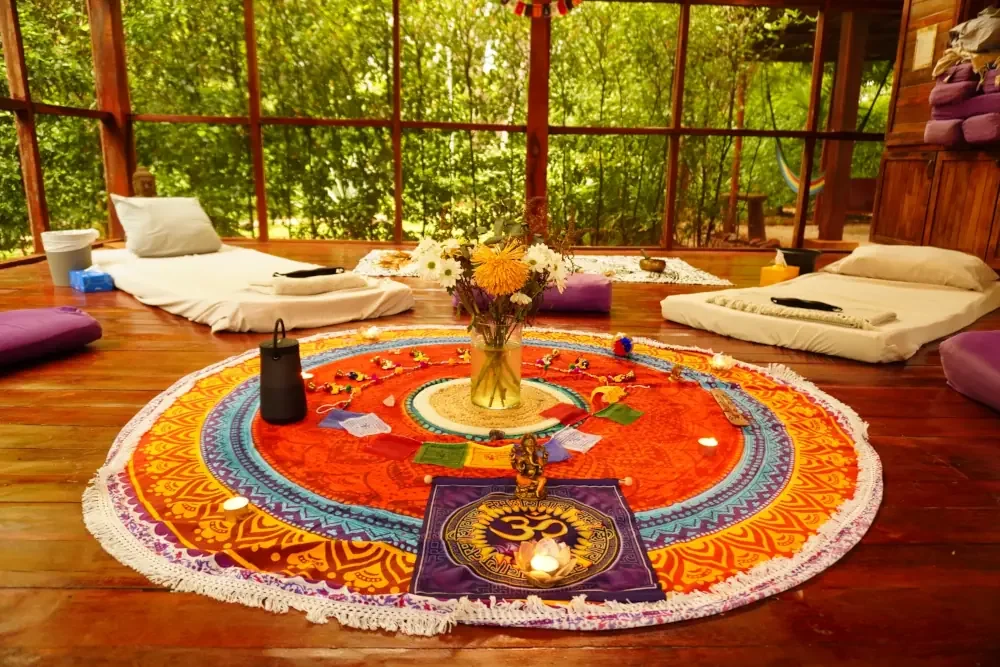
Practical example: At ACSAUHAYA’s Costa Rica retreats near Playa Negra in Guanacaste, participants complete a medical screening and preparation process before travel, arrive on Friday for 1:1 sessions with facilitators, take part in guided ceremonies in the evenings, and use the daytime for rest, sharing circles and somatic practices. Groups are deliberately small so that each participant receives individual attention. See current dates and details.
Key takeaway: The three days on site are the visible part of a longer arc. The quality of a short retreat depends on what surrounds it: screening, preparation and integration.
Is Ayahuasca Legal in Costa Rica?
Ayahuasca is not specifically scheduled or prohibited under Costa Rican law. There is no statute that explicitly permits or bans the traditional brew, and retreat centers operate openly across the country. This differs from the United States and Canada, where DMT, one of ayahuasca’s active compounds, is a federally controlled substance.
Because there is no specific regulation, the accurate description of Costa Rica is a permissive, unscheduled environment rather than formal legalization. In practice, ayahuasca retreats have operated publicly in Costa Rica for many years, and the country has become one of the most established destinations worldwide for plant medicine programs. In January 2025, Costa Rica’s Ministry of Health issued a general advisory emphasizing that therapeutic practices should be conducted responsibly by qualified practitioners, which reinforces why choosing a professionally run retreat with real screening and safety protocols matters.
For travelers from the United States: participating in a retreat in Costa Rica is a different legal question from possessing or importing ayahuasca at home. Attending a ceremony in Costa Rica does not involve bringing anything across a border. Do not attempt to transport plant material internationally.
Key takeaway: Costa Rica offers an open, established environment for ayahuasca retreats. Precision matters: “not prohibited and practiced openly” is the honest framing, and reputable centers will describe it that way rather than making blanket legality claims. ICEERS is a leading international resource for ayahuasca legality, offering legal expertise, policy guidance, and support through its Ayahuasca Defense Fund.
Why Choose Costa Rica for a Short Ayahuasca Retreat?
Costa Rica combines an established plant medicine culture, direct flights from most major US cities, political stability, strong tourism infrastructure, and natural settings that support ceremonial work. For US travelers, it is the most accessible destination where the traditional Amazonian brew can be served openly by experienced facilitators.
Three factors make Costa Rica particularly suited to the 3 day format:
Accessibility. Liberia International Airport (LIR) receives direct flights from many US hubs, often under six hours. A Friday arrival and Sunday or Monday departure is realistic without extreme travel fatigue, which matters when the body is processing a demanding ceremonial experience.
Established retreat culture. Costa Rica hosts a mature ecosystem of retreat centers, which means experienced facilitators, familiar logistics and a local culture accustomed to wellness travel. This maturity does not guarantee quality at any individual center, which is why screening standards and facilitator experience remain the decisive selection criteria.
Environment. Ceremony and integration benefit from quiet, nature and distance from daily stimuli. Costa Rica’s countryside settings, like the area around Playa Negra in Guanacaste, provide warmth, natural beauty and calm without requiring deep jungle expedition logistics.
Key takeaway: For North Americans, Costa Rica offers the shortest distance between everyday life and a traditional, openly practiced ayahuasca ceremony in a safe, well-connected country.
Is 3 Days Enough for an Ayahuasca Retreat?
Three days is enough for a complete and meaningful ceremonial experience if, and only if, preparation starts before arrival and integration continues after departure. It is not enough time to process everything the experience may open. Reputable short retreats are honest about this and build support before and after the on-site days.
This is the most common and most legitimate concern about the weekend format. A useful way to think about it: the retreat is not three days long. It is a six to ten week arc in which three days are spent on site.
- Weeks before: medical screening, dietary preparation, intention setting, preparation calls.
- On site: ceremony, rest, facilitated sharing, individual sessions.
- Weeks after: integration sessions, practices for translating insights into daily life.
Who the 3 day format suits well: people with limited vacation time, people who want a professionally held first experience without a large commitment, and experienced participants returning for continued work. Who should consider a longer program instead: people working through complex trauma who want extended daily support, and anyone whose intake conversation suggests more time and slower pacing would serve them better. An honest retreat organization will tell you during screening if the short format is not the right fit.
Key takeaway: Three days on site can hold one or two profound ceremonies. Whether the experience becomes lasting change depends mostly on integration, which no retreat length can replace.
What Happens Day by Day
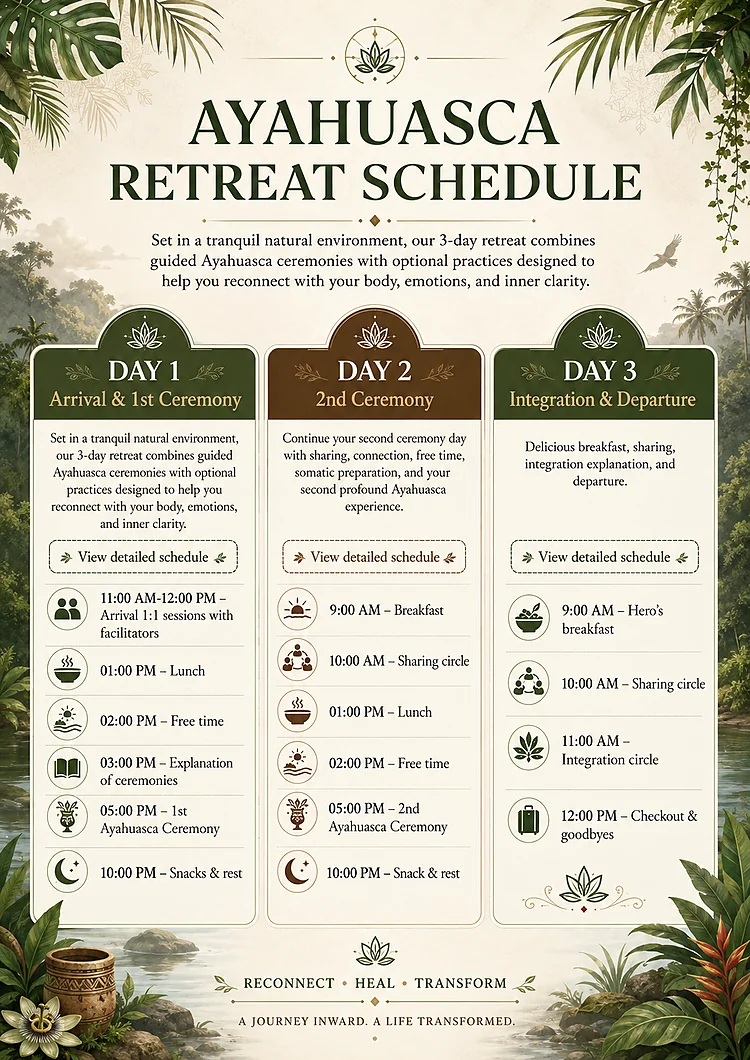
A typical 3 day ayahuasca retreat in Costa Rica runs Friday to Sunday: arrival, orientation and 1:1 facilitator sessions on day one, followed by an evening ceremony; rest, sharing circle, somatic preparation and a second ceremony on day two; and closing circle, integration guidance and departure on day three.
Day 1: Arrival and First Ceremony
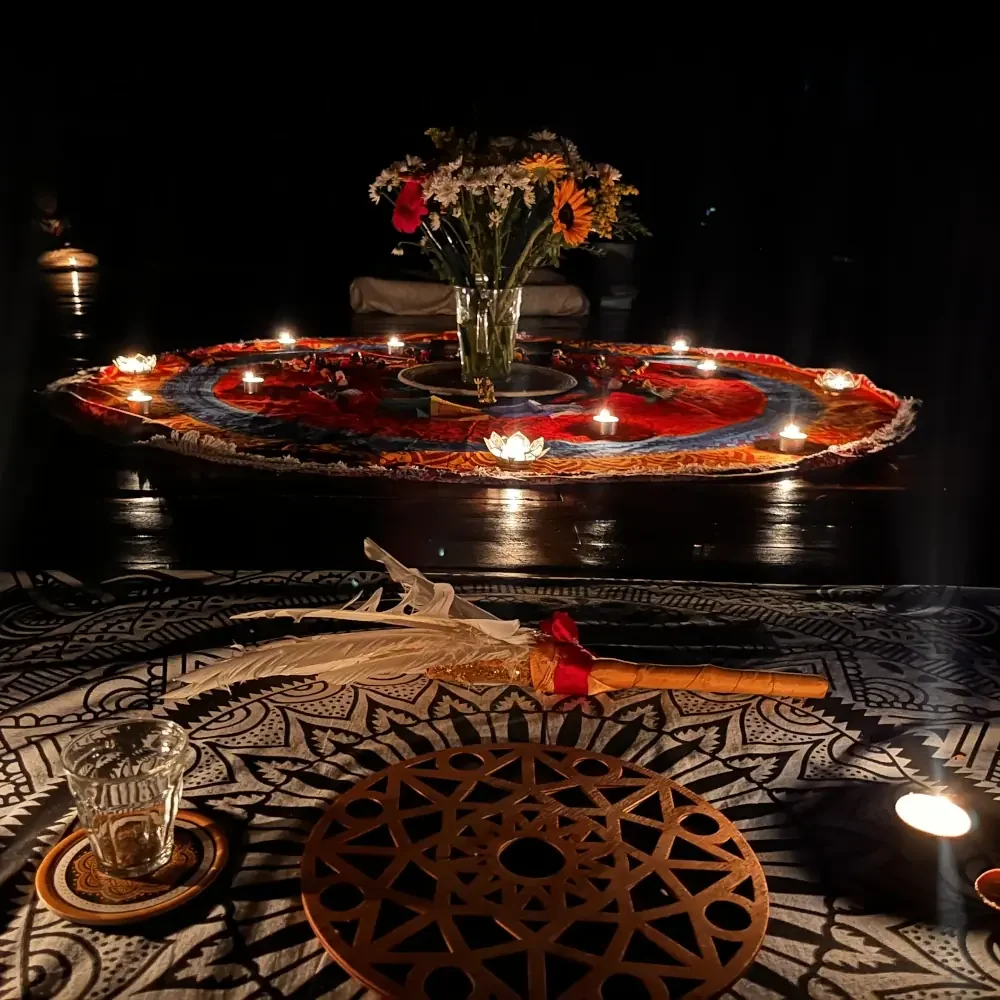
Participants arrive around midday, settle in, and meet individually with facilitators. These 1:1 sessions matter: the facilitator hears your intention, reviews anything from your screening that needs attention, and answers final questions. After a light early dinner window and quiet preparation time, the first ceremony is held in the evening. Ceremonies typically last several hours, with facilitators and support staff present at all times, and participants resting on mats in a shared ceremonial space.
Day 2: Processing and Second Ceremony
The morning after a ceremony is slow by design. A shared breakfast, rest, and a facilitated sharing circle where participants can voice what happened, without pressure to interpret or perform. The afternoon often includes somatic practices, gentle movement or time in nature, which helps the body settle before the second ceremony that evening. The second ceremony frequently goes deeper: the body knows the process, and intentions have sharpened.
Day 3: Closing and Integration Bridge
The final morning centers on a closing circle and concrete integration guidance: what to expect in the first days at home, how to protect rest, journaling and grounding practices, and how post-retreat integration support works. Departure follows around late morning or midday.
Key takeaway: The rhythm is deliberate: ceremony at night, processing by day, and an explicit bridge back to ordinary life at the end. Nothing in a good program is filler.
The Brew: What Is Served at a Costa Rica Ceremony
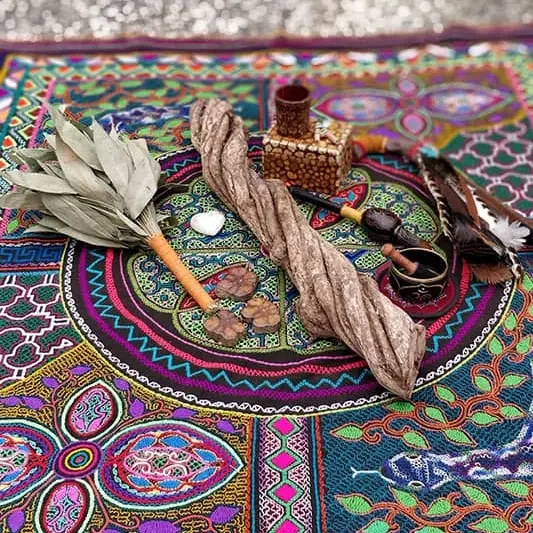
In Costa Rica, ceremonies use the traditional Amazonian ayahuasca brew: a decoction of the Banisteriopsis caapi vine combined with Psychotria viridis (chacruna) leaves. The chacruna contributes DMT and the vine contributes harmala alkaloids that make it orally active. This is the combination used for generations in Amazonian ceremonial traditions.
Understanding the brew helps set expectations. The effects typically begin 30 to 60 minutes after drinking, unfold over roughly four to six hours, and can include intense emotional material, visual phenomena, physical purging (vomiting is common and traditionally considered part of the cleansing process), and periods of deep introspection. The experience is demanding. Reputable facilitators never describe it as easy or purely blissful, because honest expectations are themselves a safety measure.
A note on ACSAUHAYA’s two locations: ACSAUHAYA also holds legal ceremonies in the Netherlands, where a different, fully legal construction is used (the Banisteriopsis caapi vine, which contains no DMT, combined with legal psilocybin truffles). The Costa Rica retreats described in this guide work with the traditional vine and chacruna brew. Participants choosing between locations can discuss the differences during an intake conversation.
Key takeaway: In Costa Rica you receive the traditional Amazonian preparation. Know what it contains, respect its intensity, and choose facilitators who talk about it honestly.
Safety, Screening and Contraindications
Safe ayahuasca retreats are built on mandatory medical screening before booking is confirmed. Key contraindications include SSRIs, MAOIs, lithium and certain other medications, cardiovascular conditions, and personal or close family history of psychosis, schizophrenia or bipolar I disorder. A retreat that does not screen for these should be avoided regardless of price or reviews.
Ayahuasca interacts with the serotonin system. Combining it with serotonergic medication can cause serotonin syndrome, a medical emergency. This is why screening is not paperwork theater but the single most important safety mechanism a retreat has. A serious screening process reviews:
- Medications: antidepressants (SSRIs, SNRIs, MAOIs), lithium, certain blood pressure and heart medications, some migraine and pain medications. Some medications require supervised tapering with your prescribing physician well before the retreat; never stop medication on your own.
- Psychiatric history: psychotic disorders, bipolar I, current severe instability. These are typically firm exclusions, for the participant’s protection.
- Cardiovascular health: ayahuasca raises heart rate and blood pressure during ceremony.
- Pregnancy
- Certain other physical conditions.
Beyond screening, ask any retreat these questions before booking: How many facilitators and support staff are present per participant during ceremony? What is the emergency protocol and how far is the nearest medical facility? Is informed consent documented? Are facilitators experienced with difficult moments during ceremony? At ACSAUHAYA, every participant completes a medical screening before confirmation, groups are kept small, and facilitators with more than 15 years of ceremonial experience hold the ceremonies with support staff present throughout.
If you have an existing medical or psychiatric condition, consult your own physician before applying to any retreat. A trustworthy center will welcome that conversation rather than discourage it.
Key takeaway: Screening quality is the clearest signal separating professional retreats from risky ones. If booking and joining a retreat is possible without a health review, walk away.
How to Prepare for a 3 Day Retreat
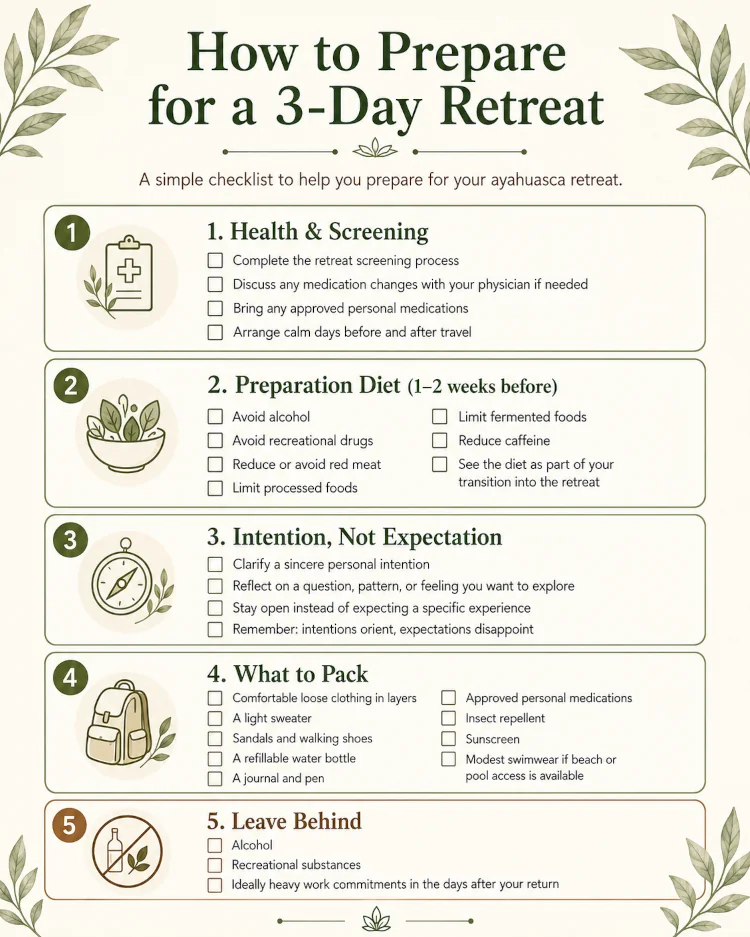
Preparation for an ayahuasca retreat has three layers: dietary (reducing or eliminating alcohol, recreational drugs, heavy and fermented foods in the one to two weeks prior), medical (completing screening and any physician-supervised medication adjustments), and psychological (clarifying an intention and arranging calm days before and after travel).
The Preparation Diet
Most centers ask participants to follow a simplified version of the traditional dieta in the days or weeks before ceremony: no alcohol or recreational drugs, reduced or eliminated red meat, minimal processed and fermented foods, and reduced caffeine. Beyond any pharmacological rationale, the diet functions as a transition ritual: the process begins at home, not at the airport.
Intention, Not Expectation
Facilitators consistently observe that participants who arrive with a clear, honest intention (a question, a pattern they want to look at, a grief they want to meet) navigate ceremonies better than those chasing a specific experience they read about online. Intentions orient; expectations disappoint. The experience rarely matches predictions, and that is not failure.
What to Pack
Comfortable loose clothing in layers (ceremonies run into the night), a light sweater, sandals and walking shoes, a refillable water bottle, a journal and pen, any permitted personal medications discussed during screening, insect repellent, sunscreen, and modest swimwear if the location offers beach or pool access. Leave: alcohol, recreational substances, and ideally, heavy work commitments in the days after return.
Key takeaway: Preparation is where a 3 day retreat earns its depth. Participants who prepare seriously often describe the retreat as the midpoint of the process rather than the whole of it. Here you can find more information about how to prepare for an ayahuasca ceremony.
Integration: What Happens After You Go Home
Integration is the structured process of translating ceremonial insights into daily life. After a 3 day retreat it typically includes rest in the first days, journaling, follow-up integration sessions with the retreat’s team or an integration coach, and concrete behavioral steps derived from the experience. Without integration, even powerful ceremonies tend to fade into memory rather than change.
The first 72 hours at home matter most. Common recommendations: protect sleep, avoid alcohol, delay major decisions, spend time in nature, and write. Emotional waves in the first week are normal; the process continues after the ceremony ends.
Structured integration support distinguishes serious retreat organizations from event operators. ACSAUHAYA’s approach includes post-retreat integration support with its multidisciplinary team, which includes psychologists, therapists and integration coaches, so that participants are not left alone with significant material. Scientific literature on psychedelic-assisted approaches, including research programs at institutions such as Johns Hopkins, Imperial College London, and MAPS consistently emphasizes that preparation and integration context shapes outcomes, which aligns with what ceremonial traditions have practiced for generations. (Note: referencing published research; ACSAUHAYA is not affiliated with these institutions.)
Key takeaway: Budget as much attention for the two weeks after the retreat as for the retreat itself. That is where insight becomes change.

Travel, Location and Logistics
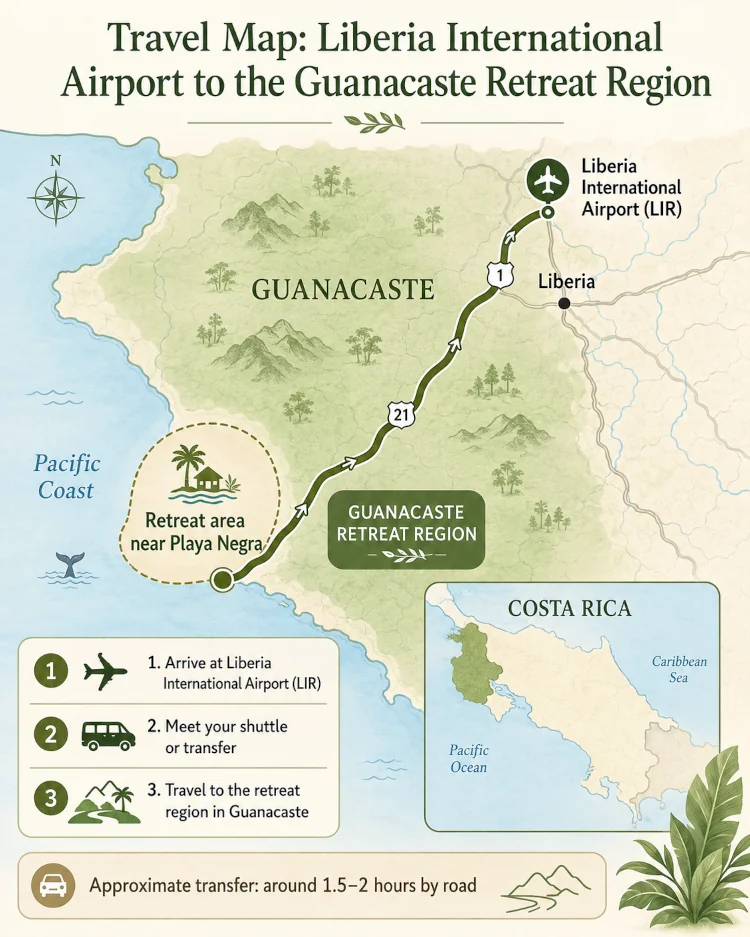
For a 3 day ayahuasca retreat in Guanacaste, Costa Rica, fly into Liberia International Airport (LIR), which has direct connections from many US cities. Plan to arrive Friday around midday and depart Sunday afternoon or, more comfortably, Monday. US and Canadian citizens do not need a visa for short tourist stays.
Practical notes for US travelers:
- Airport: Liberia (LIR) is the right choice for Guanacaste retreats; San José (SJO) adds hours of driving. ACSAUHAYA’s retreat location near Playa Negra is a short transfer from Liberia, and full travel details are provided after booking.
- Transport: shuttle transfer from Liberia International Airport (LIR) is included with all our retreats. The exact pick-up location will be provided after booking.
- Timing: the dry season (roughly November to April) offers the most predictable weather; green season retreats trade occasional rain for lush landscapes and quieter travel.
- Buffer days: if your schedule allows, flying home Monday rather than Sunday evening gives the body one more night of rest after the second ceremony.
- Money and connectivity: US dollars are widely accepted; retreats typically encourage limited phone use during the program.
Key takeaway: Logistics for Costa Rica are simple by plant medicine standards: one direct flight, one transfer, no visa for most North Americans.
What Does a 3 Day Retreat Cost and What Is Included?
A professionally run 3 day ayahuasca retreat in Costa Rica generally includes accommodation, meals, medical screening, one or two ceremonies, 1:1 facilitator sessions, group integration circles and post-retreat support. Flights and sometimes ground transport are excluded. Price varies with group size, facilitator ratio and accommodation level; unusually cheap offers usually economize on exactly the things that keep participants safe.
Rather than anchoring on a number, evaluate what the price buys:
| What to compare | Why it matters |
|---|---|
| Medical screening before booking | The core safety mechanism |
| Group size | Smaller groups mean real individual attention (ACSAUHAYA caps Costa Rica groups at 13) |
| Facilitator experience | Years of ceremonial experience, not marketing language |
| Staff-to-participant ratio in ceremony | Support during difficult moments |
| Preparation support | Calls and guidance before arrival |
| Integration support | Structured follow-up, not a goodbye email |
| Accommodation and food | Comfort supports the process but should not be the main selling point |
Key takeaway: Compare containers, not just prices. The cheapest retreat is expensive if it lacks screening, experienced facilitators or integration. You can see exactly what ACSAUHAYA’s 3 day Costa Rica retreat includes on the retreat page, item by item.
Common Misconceptions About Short Ayahuasca Retreats
The most common misconceptions are that a weekend retreat is “ayahuasca tourism lite,” that one ceremony guarantees transformation, that ayahuasca is a treatment for medical or psychiatric conditions, and that a difficult ceremony means something went wrong. None of these hold up against ceremonial experience or the research literature.
“A short retreat cannot be serious.” Depth comes from the container (screening, facilitation, integration), not from the calendar. A poorly held 10 day retreat is less serious than a rigorously held weekend.
“Ayahuasca will fix me.” Ayahuasca is not a medical treatment and no reputable retreat should present it as one. Research into psychedelics and mental health is promising but ongoing, and ceremonial participation is not therapy. People with clinical conditions need clinical care; a retreat can at most be a complement, discussed with one’s own health professionals.
“If nothing dramatic happens, it failed.” Quiet ceremonies are common and often prove significant weeks later. Facilitators with long experience see this pattern constantly.
“A hard ceremony means bad facilitation.” Difficulty is intrinsic to the work. What distinguishes good facilitation is how difficulty is held: presence, support and follow-up, not the promise of comfort.
Key takeaway: Honest retreats under-promise. Be more skeptical of guarantees than of warnings.
Frequently Asked Questions
Conclusion
A 3 day ayahuasca retreat in Costa Rica can be a serious, well-held ceremonial experience when it is embedded in real preparation, rigorous screening and structured integration. Costa Rica’s openness to traditional plant medicine, its accessibility from North America and its natural calm make it the most practical setting for a short format retreat, and the traditional vine and chacruna brew connects the experience to generations of Amazonian ceremonial practice.
The decisive questions are never about the destination photos. They are: Who screens me? Who holds the ceremony, and with how much experience? Who is there when it gets difficult? And who is still there two weeks after I fly home?
Key Takeaways
- A 3 day retreat is the on-site core of a longer arc: preparation before, integration after.
- Costa Rica does not specifically prohibit ayahuasca; retreats operate openly, and precision about this is a trust signal.
- The Costa Rica brew is the traditional B. caapi and chacruna preparation; expect intensity, not comfort.
- Medical screening (medications, psychiatric history, cardiovascular health) is the non-negotiable safety foundation.
- Small groups, experienced facilitators and structured integration matter more than amenities or price.
Considering a Retreat?
ACSAUHAYA holds small-group 3 day ayahuasca retreats in Guanacaste, Costa Rica, guided by facilitators with more than 15 years of ceremonial experience and supported by a multidisciplinary team of psychologists, therapists and integration coaches. Every participant completes a medical screening before confirmation.
If you want to explore whether this retreat, or a different format, fits your situation, view the current Costa Rica retreat dates and details or request an intake conversation. There is no obligation, and if our screening suggests this is not the right step for you, we will say so.