



Private Ayahuasca Retreat in Costa Rica: The Complete Guide
7 August 2026
A private ayahuasca retreat in Costa Rica is a ceremony program designed around one person, a couple or a small self-formed group, with the traditional jungle brew (Banisteriopsis caapi and Chacruna), personal screening, a dedicated ceremony leader, and integration support. This guide explains how it differs from group retreats, what it costs, and how to choose safely.
Table of Contents:
What Is a Private Ayahuasca Retreat?
A private ayahuasca retreat is a retreat where the entire program, including the ceremony itself, is built around you alone, you and a partner, or a small group you form yourself. You do not join strangers. The schedule, the pacing, the depth of preparation and the ceremony space are shaped around one process instead of averaged across a group.
In Costa Rica, private retreats work with the traditional jungle brew: the ayahuasca vine (Banisteriopsis caapi) combined with Chacruna (Psychotria viridis), prepared in the way Amazonian traditions have prepared it for generations. That is a meaningful difference from our work in the Netherlands, where we serve our legal Dutch brew of the vine together with legal psilocybin truffles. Two locations, two clearly different brews, each offered where it belongs.
The core elements of a serious private retreat are the same as those of a serious group retreat: an honest intake and medical screening, structured preparation, ceremonies held by an experienced ceremony leader, and integration support afterwards. What changes is the level of personal attention, the flexibility, and the privacy.
A private ayahuasca retreat in Costa Rica is a personalized ceremony program for one person, a couple or a self-formed small group, using the traditional jungle brew of ayahuasca vine and Chacruna. It includes individual screening, dedicated facilitation, a flexible schedule and one-on-one integration support, with full privacy throughout.
Key takeaways
- Private means the program is designed around one process, not a group average.
- In Costa Rica, ceremonies use the traditional jungle brew: the vine with Chacruna.
- Screening, preparation and integration remain non-negotiable, private or not.
Private vs. Group Retreat: The Honest Comparison
The honest answer is that neither format is better; they serve different needs. Our 3-Day Ayahuasca Retreat in Costa Rica, in a group setting offers shared humanity and a lower price. A private retreat offers privacy, flexibility and undivided attention. The comparison below is based on what we see in practice, on both sides.
| Group Retreat | Private Retreat | |
|---|---|---|
| Attention | Shared across the group, with a fixed facilitator-to-participant ratio | Undivided; the ceremony leader holds only your process |
| Privacy | Sharing circles with strangers; discretion depends on the group | Complete; nobody outside the team knows you are there |
| Schedule | Fixed dates and program | Dates and pacing arranged around you |
| Ceremony dynamics | The group field can carry and deepen the experience | The space is quiet and undiluted; nothing in the room but your process |
| Sharing and mirroring | Hearing others’ processes can unlock your own | Reflection happens one-on-one with the team |
| Cost | Lower per person | Higher, because a full team holds one process |
| Best fit for | First encounters, those who draw strength from community | Public figures, couples, deep personal themes, those who need flexibility or discretion |
One thing we tell people honestly: some participants who assume they want privacy discover that the group is exactly the medicine they needed. Others know from the first phone call that they will only be able to surrender in a private setting. Both are valid, and a good intake conversation usually makes the right format obvious.
Key takeaways
- Group retreats offer community and mirroring; private retreats offer privacy and flexibility.
- Ceremony dynamics differ genuinely: group field versus undiluted personal space.
- The right format usually becomes clear in an honest intake conversation.
Who Chooses a Private Retreat, and Why
After more than 15 years of holding ceremonies, we see the same motivations return in those who ask for a private setting. Recognizing yourself in one of these is often the clearest signal that private is the right format for you.
Privacy by profession or position. Entrepreneurs, physicians, public figures and leaders whose presence at a retreat is nobody’s business. For them, discretion is not a luxury; it is the precondition for being able to let go at all.
Couples and family members. Two people who want to go through this process side by side, with space for what surfaces between them, without an audience. This is delicate work that deserves its own container.
Deeply personal themes. Grief, old trauma, shame-laden material. Some processes ask for a space where nothing needs to be shared with strangers, ever.
The need for pacing. Some people need a slower build-up, longer conversations before the first ceremony, or an extra day of rest in between. A private program can breathe in a way a fixed group schedule cannot.
A previous retreat that went too fast. We regularly welcome people whose earlier experience elsewhere was rushed or under-supported, and who now want the opposite: fewer people, more care, more time.
Key takeaways
- Discretion, intimacy, difficult themes and pacing are the four main reasons for going private.
- Couples work is a category of its own and benefits from a dedicated container.
- A private setting is often chosen the second time, after learning what was missing the first time.
Is Ayahuasca Legal in Costa Rica?
Ayahuasca is not specifically prohibited in Costa Rica, and ceremonies are practiced openly there. Costa Rican law does not explicitly regulate the traditional brew, which means retreats operate in an open and tolerated space rather than under a formal legal framework. This is different from most of Europe, where the traditional DMT-containing brew is prohibited or legally uncertain.
We choose our words carefully here, because precision is part of trustworthiness. “Not specifically prohibited, practiced openly” is the accurate description. It is not the same as a government-issued license or an affirmative legal guarantee, and any provider claiming otherwise is overstating the situation. What we can say is this: ayahuasca ceremony has an established, open presence in Costa Rica, retreats operate visibly, and the country has become one of the world’s recognized destinations for this work.
For our European retreats the situation is reversed and clearer in a different way: in the Netherlands we work exclusively with components that are affirmatively legal under Dutch law, the ayahuasca vine and legal psilocybin truffles. Two locations, two legal realities, both handled with the same transparency.
Ayahuasca is not specifically prohibited in Costa Rica and ceremonies are practiced openly throughout the country. There is no formal licensing framework, so retreats operate in an open, tolerated space. This makes Costa Rica one of the most established destinations worldwide for traditional ayahuasca ceremony.
Key takeaways
- Costa Rica: not specifically prohibited, practiced openly, no formal licensing framework.
- Precise language matters; be wary of providers claiming absolute legal guarantees.
- The Netherlands offers the opposite model: affirmatively legal components under Dutch law.
- ICEERS provides further helpful legal information and resources about harm reduction
The Traditional Jungle Brew
In Costa Rica we work with the traditional jungle brew: the ayahuasca vine (Banisteriopsis caapi) combined with Chacruna (Psychotria viridis), the DMT-containing leaf that Amazonian traditions have paired with the vine for generations. This is ayahuasca as it has been prepared and served in the Amazon basin, brought to a setting where it can be practiced openly.
Our relationship with this brew was not learned from books. For more than 15 years we have been devoted to ayahuasca work, including long practice alongside indigenous shamans from the Amazon, and that lineage shapes how our ceremony leaders hold the space in Costa Rica: with respect for the tradition the brew comes from, and with the safety standards participants rightly expect today.
Key takeaways
- The Costa Rica brew is the traditional one: vine (Banisteriopsis caapi) plus Chacruna (Psychotria viridis).
- Our practice is rooted in more than 15 years of work, including alongside indigenous Amazonian shamans.
- The Netherlands uses a different, affirmatively legal composition; the two are never mixed up.
What a Private Retreat Looks Like, Day by Day
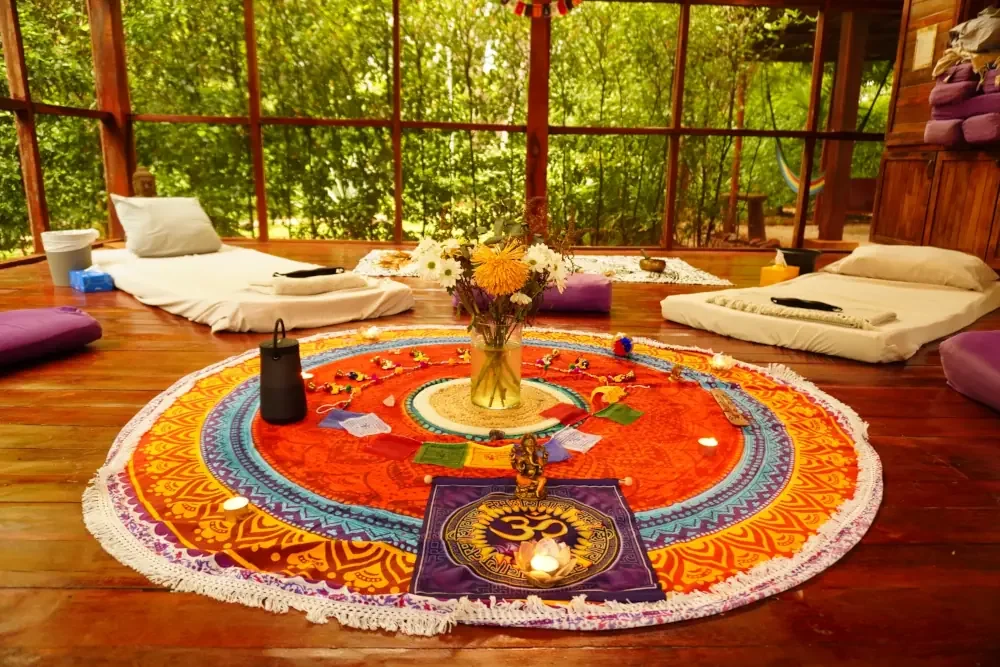
Every private program is shaped around the person in it, so no two look identical. The arc below shows a typical private retreat structure in Costa Rica, so you know what you are saying yes to.
| Phase | What happens |
|---|---|
| Before travel | Personal intake and medical screening; one or more preparation conversations; dietary guidance; intention work |
| Day 1: Arrival & 1st ceremony | Airport pickup arranged; settling into the retreat location; lunch & opening conversation with your ceremony leader; 1st Ayahuasca ceremony; snacks & rest |
| Day 2: Integration & 2nd ceremony | Breakfast & Sharing; breathwork & meditation; lunch & free time; 2nd Ayahuasca ceremony; snacks & rest |
| Day 3: Closing & departure | Breakfast & Sharing; integration explanation; checkout & goodbyes |
| After | Scheduled integration contact; availability of our integration lead for follow-up sessions |
Two things distinguish the private arc from a group program. First, the plan is allowed to breathe: if the ceremony opens something that needs time, we take the time, and an extra rest day can be added. Second, every conversation is one-on-one. There is no sharing circle unless you bring the people you want in it.
Key takeaways
- A typical Private Ayahuasca Retreat in Costa Rica spans roughly three days around two ceremonies, adjusted to your process.
- The schedule is allowed to change mid-retreat; that flexibility is the point.
- All reflection happens one-on-one, with no group sharing unless you choose it.
What Does a Private Ayahuasca Retreat in Costa Rica Cost?
A private retreat costs meaningfully more than a group retreat, because a full team holds a single process. Instead of one price per bed, you are engaging dedicated ceremony leadership, private accommodation, individual preparation and one-on-one integration for the duration of the program. Exact investment depends on the factors below, and we discuss it openly in the intake conversation.
What drives the cost of a private program:
- Team dedication: ceremony leaders and support staff who hold only your retreat during those days
- Duration: number of days and ceremonies, plus any extra rest or integration days
- Accommodation: private use of the retreat setting rather than a shared bed price
- Group size: one person, a couple, or a small self-formed group sharing the program
- Preparation and aftercare depth: additional preparation conversations and integration sessions
For current retreat options and prices, visit our page for Private Ayahuasca Retreats in Costa Rica. Before you commit, you will always receive a clear overview of the complete price, with no hidden extras during or after your retreat.
Be cautious with providers whose private pricing is either suspiciously low (usually meaning the “private” retreat is a group retreat with a private room) or entirely opaque. Ask exactly what is dedicated to you: the team, the space, the schedule, or only the bedroom.
Key takeaways
- Private pricing reflects a dedicated team and space, not just a private room.
- Cost follows program design: duration, group size, preparation and aftercare depth.
- Demand a complete, transparent quote and ask precisely what is exclusively yours.
Safety and Screening in a Private Setting
Safety standards do not relax because a retreat is private; if anything, the screening becomes more personal. Every private participant goes through the same medical and psychological intake as our group participants, and we decline when it is not safe to proceed.
The contraindications are the same ones we apply everywhere: a personal or close family history of psychosis, schizophrenia or bipolar disorder; certain medications, including specific antidepressants; serious heart conditions; pregnancy; and acute psychological crisis, where stabilization comes first. The traditional brew also comes with its own dietary and medication interaction requirements, which we walk through with you individually during preparation.
What the private setting adds is depth of attention. Your ceremony leader knows your history, your medication picture and your intention in detail before the first cup is poured, and holds only your process through the night. For demanding personal themes, that concentration of attention is itself a safety feature.
One honest boundary: a private retreat is not a medical treatment and we never present it as one. For some situations, therapy or medical care is the right first step, and our screening exists to say so when it is true.
Key takeaways
- Screening and contraindications are identical to group retreats; privacy changes nothing there.
- The traditional brew carries its own dietary and medication interaction requirements.
- Concentrated one-on-one attention is itself a safety feature for heavy themes.
Preparation and Travel Logistics
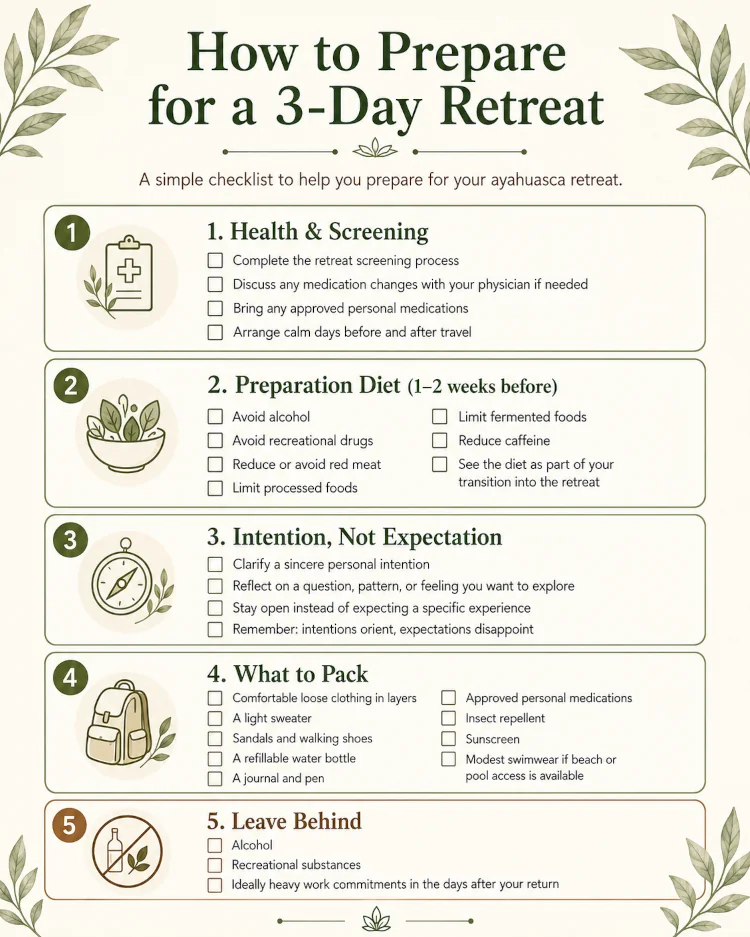
Preparation for a private Costa Rica retreat covers the same three areas as any serious ceremony: body, mind and intention, plus the practical layer of international travel. You receive full personal guidance after booking; the outline below covers what most people ask first.
Preparation: in the weeks before, you follow dietary guidance specific to the traditional brew, complete your medication review, and have at least one preparation conversation with the team. The final days before travel are for slowing down: less stimulation, more rest, clarity of intention.
Getting there: most international guests fly into San José (SJO) or Liberia (LIR), depending on the retreat location. Transport from the airport is arranged as part of a private program, so you are received rather than left to navigate.
When to go: Costa Rica’s dry season, roughly November through April, is the most popular travel window, though retreats run year-round; the green season brings rain, fewer travelers and a quieter country.
Practicalities: most European and North American passport holders do not need a visa for short tourist stays. Check your government’s current travel guidance before booking flights, and plan at least one buffer day after the retreat before flying home; landing gently matters more than landing quickly.
Key takeaways
- Preparation combines brew-specific dietary guidance, medication review and intention work.
- Airport transfer and logistics are handled as part of a private program.
- Plan a buffer day after the retreat; do not fly home straight from ceremony.
Integration After a Private Retreat
Integration is where a powerful week in Costa Rica becomes lasting change at home, and in a private program it continues one-on-one. Before you leave, you have a dedicated integration conversation: what surfaced, what it asks of you, and what the first weeks should look like.
After you return home, the team remains reachable, and our integration lead is available for follow-up sessions when deeper themes keep moving. Private participants often carry demanding material, which is precisely why the aftercare is personal rather than a group call.
The rhythm we recommend is the same one that serves all ceremony work: rest and gentle routine in the first days, honest conversations and reflection in the first weeks, and gradual, concrete behavior change in the months after. Insight is the beginning; integration is the work.
After a private ayahuasca retreat, integration continues one-on-one: a closing conversation before departure, reachable contact with the team in the first weeks, and optional follow-up sessions with an integration specialist. The goal is translating ceremony insights into concrete changes in daily life, at a sustainable pace.

How to Choose a Private Retreat Provider
A trustworthy private ayahuasca retreat in Costa Rica combines verifiable experience, real screening, a genuinely dedicated team, transparent pricing and structured aftercare. Use these seven questions when comparing providers, including us:
- How many years has the team held ceremonies, and where does its lineage come from? Vague answers are answers.
- Is the screening real? Ask what would disqualify you. A provider that declines nobody protects nobody.
- What exactly is private? The team, the space and the schedule, or only your bedroom?
- Who leads the ceremony, and will you speak with them before booking? You are trusting this person with your deepest night; a call beforehand is reasonable.
- What does the complete price include? Preparation, ceremonies, accommodation, transfers, integration. In writing.
- What happens after you fly home? Structured aftercare, or a goodbye at the gate?
- How do they talk about outcomes? Anyone promising healing or transformation on a schedule is selling, not facilitating.
We answer all seven openly in a personal conversation, with our more than 15 years of ceremonial experience, our screening standards and our integration structure on the table. Rated 5.0 on Google across 260+ reviews, and happy to let critical questions test that.
Key takeaways
- Seven questions separate serious providers from packaged experiences.
- “Private” should mean the team and schedule, not just the bedroom.
- Outcome promises are the clearest red flag in this field.
Frequently Asked Questions
Conclusion: Your Next Step
A private ayahuasca retreat in Costa Rica is the most personal form this work can take: the traditional jungle brew, held in a country where ceremony is practiced openly, with a team that holds only your process. It is not the right format for everyone, and it is more of an investment than a group retreat. But for those who need privacy, pacing or a container built entirely around them, it is often the setting in which the deepest work finally becomes possible.
Whatever you decide, decide it well informed: real screening, verifiable experience, transparent pricing, structured integration. Those four things separate serious work from packaged experiences, anywhere in the world.
If a private program in Costa Rica speaks to you:
- Learn about our private ayahuasca retreats in Costa Rica
- Read how we approach preparation and integration
- Or contact us for a personal, confidential conversation about a private program
Bring your questions, including the difficult ones. That conversation is where every good retreat begins.